The Hume Society

Stimulating Scholarship on the Writings of David Hume

Society News

Hume Studies “DISPUTED QUESTION” Competition

The editors of Hume Studies invite submissions of up to 3,000 words addressing the following “disputed question” in Hume scholarship. Deadline for submissions is 28 February, 2027 (midnight, Edinburgh time). Top entries to be selected for publication in a single, co-authored article to appear in the June 2027 issue of Hume Studies.

Question (with a tip of the hat to Jonny Cottrell): What is the Appendix’s “counterbalancing” argument?

Background: At T App.10 Hume proposed to “examine the arguments on both sides, beginning with those that induc’d me to deny the strict and proper identity of a self or thinking being.” He then went on at some length reviewing arguments. But he did not make clear when (if ever) he switched to offering arguments for the other side. What was the argument (or what were the arguments) on the other side (or why should we think he did not offer any arguments on the other side)?(And, implicitly, what was the other side, exactly?)

Answers are to be focused on the analysis of Hume’s text. In the best medieval Quaestiones Disputatae tradition, references to the secondary literature should be confined to pithy comments on the few works most directly pertinent to the answer being given. This is not a literature review! Answers may take the form of new arguments in favour of a previously published position, new counterarguments against previously published objections to a previously published position, new arguments against a previously published position, or new positions. Attempts at mediation between or reconciliation of opposed positions are neither required nor recommended. But to each their own.

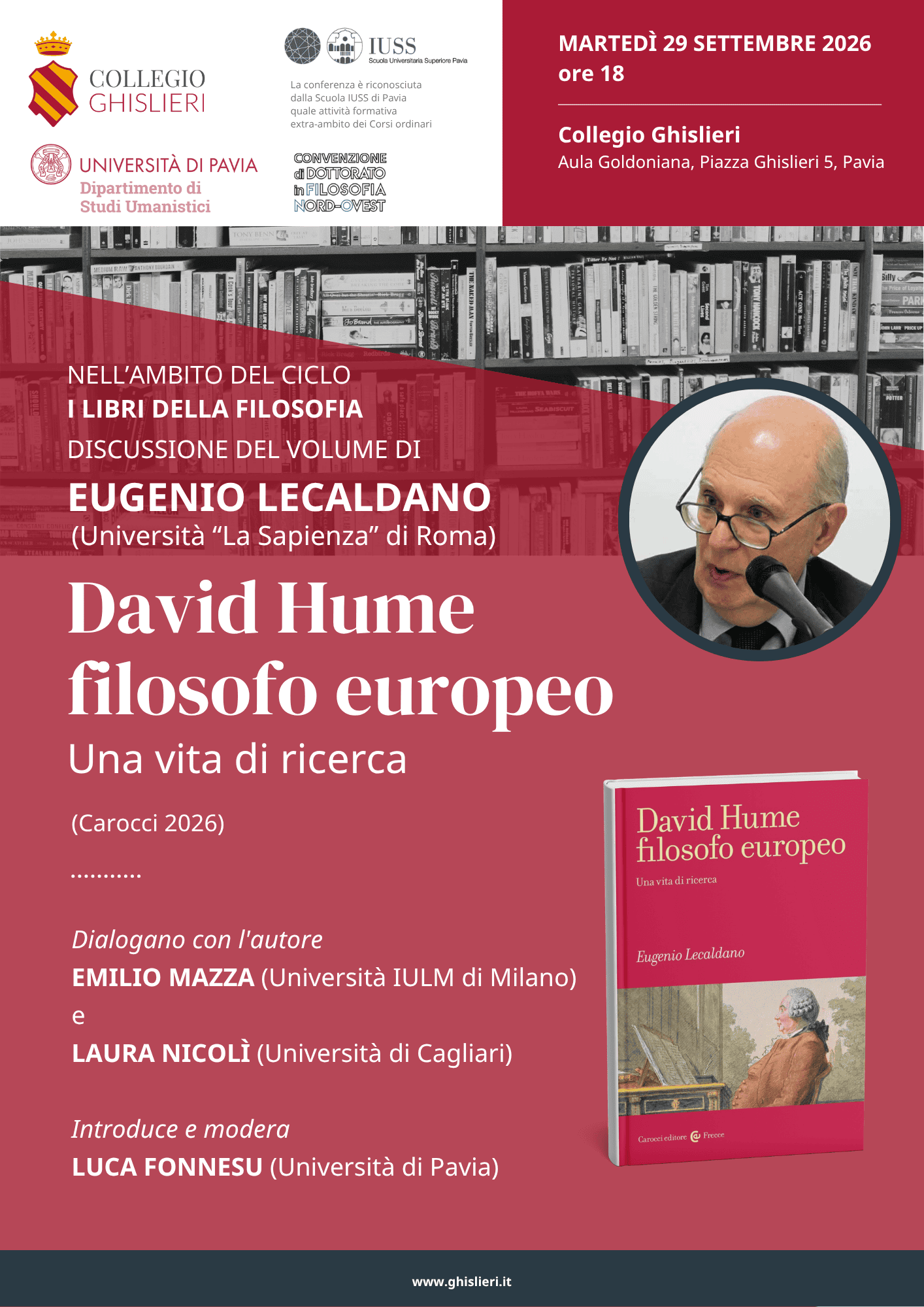
Discussione: Eugenio Lecaldano’s David Hume
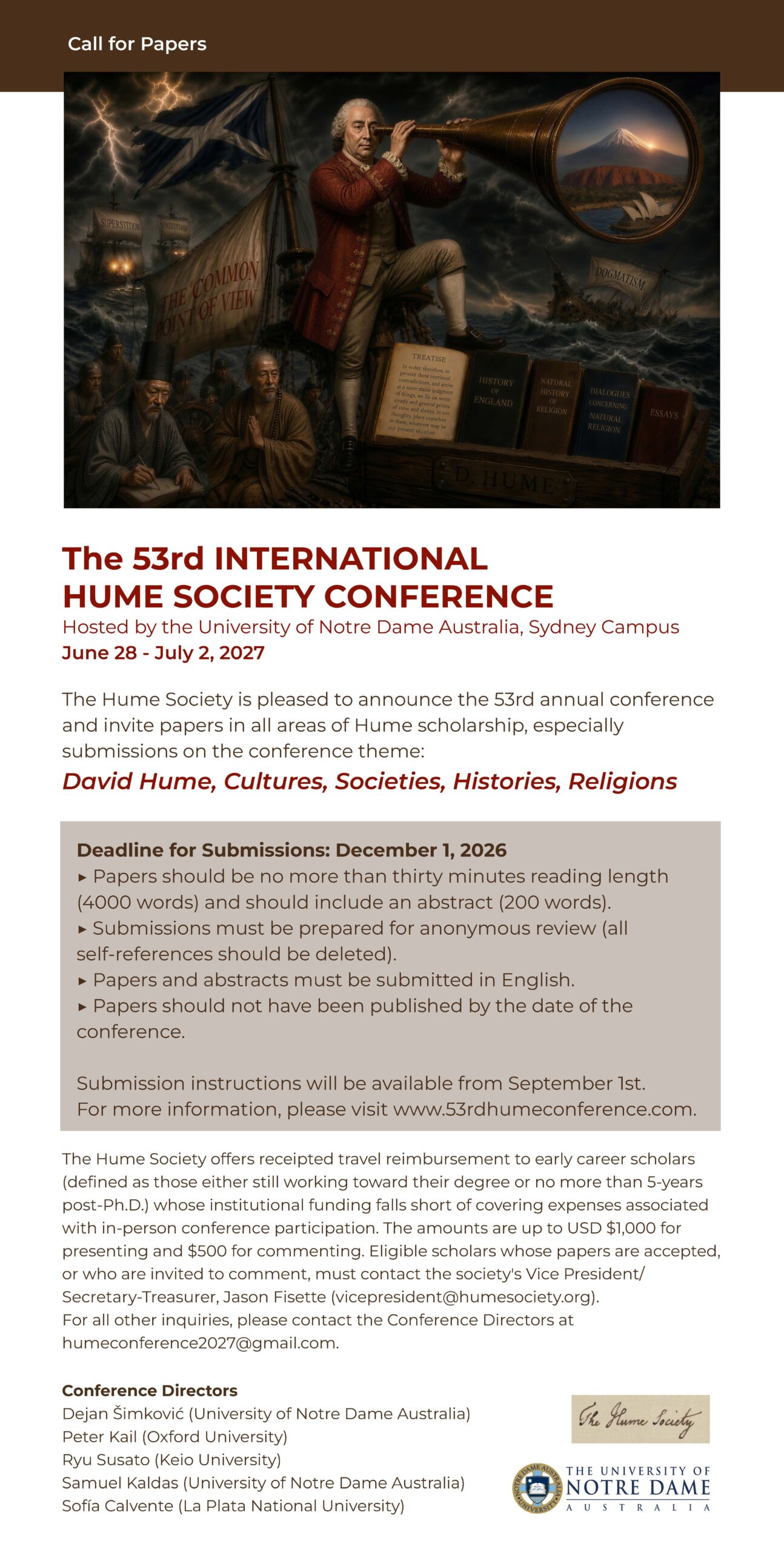
Call for Papers: 53rd Hume Society Conference, Sydney (28 June-2 July 2027)
About The Hume Society

History and Purpose

Founded in 1974, the Hume Society is an international organization of scholars from dozens of countries. Its purpose is to stimulate scholarship on all aspects of the thought and writings of David Hume, the 18th-century Scottish philosopher, historian and essayist. Membership in the society is open to everyone interested in Hume and his philosophical and literary contemporaries.

Conferences

The Hume Society holds conferences each year, with a program of papers and formal comments, along with the Society’s annual business meeting. Papers submitted for Hume Conferences are subject to anonymous review. Hume Society Emerging Scholars Awards are given to qualifying graduate students whose papers have been accepted through the normal anonymous-review process. To comply with U.S. tax policy, these awards are made in the form of receipted travel reimbursement.

The Society also organizes group sessions at the Eastern, Central, and Pacific Division meetings of the American Philosophical Association, as well as at the meeting of the Canadian Philosophical Association. Special meetings are also held, either independently or sponsored jointly with other societies.

Publications

Members of the Hume Society receive the journal Hume Studies, which is published twice yearly in April and November under the auspices of the Society. In addition, members have full access to the Hume Studies Issues Archive, an online archive of the journal.

Hume Studies awards an annual Hume Studies Essay Prize. The annual competition is open to those ten or fewer years from the Ph.D., including those currently enrolled in a Ph.D. program. The winning paper will be published with acknowledgment in Hume Studies, and the author will receive USD $1,000. For full details and requirements, see the Hume Studies Journal Site.

The Hume Society provides access to the Parallel References Guide.

Image credit: National Galleries of Scotland.